
Media Analysis: Is AI Becoming the Common Thread Across University Subjects?
Updated: Aug 30
Original Article: The AI boom means everyone wants to dabble in computer science
Publisher: Associated Press
Author: Heather Hollingsworth
Publication Date: 3rd August 2026
Summary of the original article:
AI has traditionally been associated with computer science. But a recent Associated Press article suggests that this boundary is becoming increasingly difficult to maintain.
The article, authored by Heather Hollingsworth and titled “At colleges, the AI boom means everyone wants to dabble in computer science,” explores a growing trend across US universities: students from disciplines far beyond computer science are increasingly seeking opportunities to study artificial intelligence and related subjects.
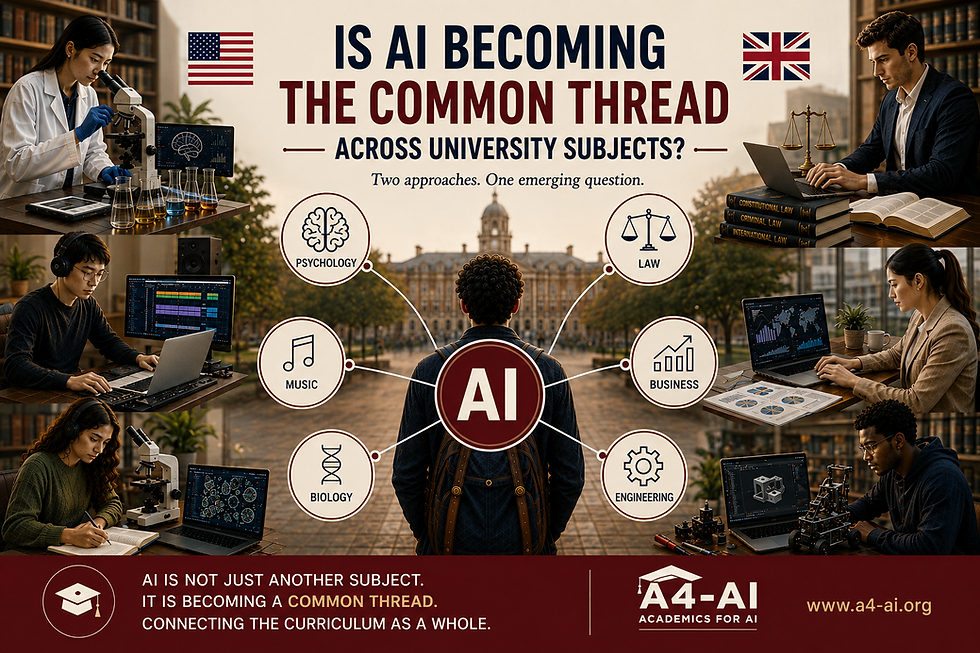
The article highlights students from areas such as psychology, music and biology who are engaging with computer science and AI, alongside universities developing courses and programmes designed to make AI accessible to students without a traditional computing background. The motivational reasons vary. Some students see AI knowledge as increasingly important to their future careers, while others are interested in how AI intersects with their particular field of study.
The development reflects a broader change in the relationship between AI and higher education. AI is no longer being treated solely as a specialist field for computer science students. Students studying other disciplines are increasingly recognising that AI will influence the professions they are preparing to enter.
However, it is important to recognise that the US approach described in the article cannot simply be transferred to other higher education systems.
In the United States, undergraduate students commonly have greater opportunities to combine a major subject with a minor or additional field of study. The examples in the AP article therefore reflect a particular feature of the US higher education model.
The UK’s university system is structured differently, with courses less likely to have a major/minor configuration. It is therefore perhaps not surprising that a different approach to equipping students with AI skills is emerging in the UK.
As an example, the University of Surrey has announced that, from September 2026, AI will be embedded in every degree programme, with teaching designed around the specific discipline being studied.
Taken together, these developments suggest that AI is beginning to move beyond the boundaries of a single academic discipline.
Why it matters for A4-AI (Academics for AI):
The significance of these developments is not that one approach is necessarily better than the other. Instead, they raise a much broader question about the future structure of university education.
A psychology student may need to understand AI differently from an engineering student. A business student may need to evaluate AI outputs differently from a historian. A medical student will encounter very different questions of accuracy, accountability and professional responsibility from a student studying music or the creative arts.
As AI becomes relevant to an increasing number of professions, should universities treat AI as another area of knowledge that students can study alongside their chosen discipline?
Or should AI become something that is increasingly embedded within the discipline itself?
The distinction matters.
The University of Surrey's approach is particularly interesting because it explicitly recognises this. Its new 2026 model is that students should learn to judge AI according to the demands of their own discipline.
In contrast, the AP article provides evidence of students in the United States moving towards AI from a variety of academic backgrounds, including through AI minors and other forms of AI study.
For all their differences, perhaps these are not competing approaches at all. They may simply represent different ways of pursuing the same objective, shaped by the teaching frameworks and traditions of the two countries.
Questions for Academia:
The approaches highlighted by the AP article covering American universities and The University of Surrey story point towards two possible models: students choosing to study AI as an additional subject, or universities embedding AI capability directly into existing disciplines. These two approaches raise distinct questions;
1. Should AI be taught as a subject — or embedded across subjects?
2. Should every university graduate develop some form of AI capability?
3. What does "AI-ready" actually mean in different disciplines?
4. How can university courses embed AI without weakening disciplinary expertise?
5. Will we see different approaches across different countries?



Comments